
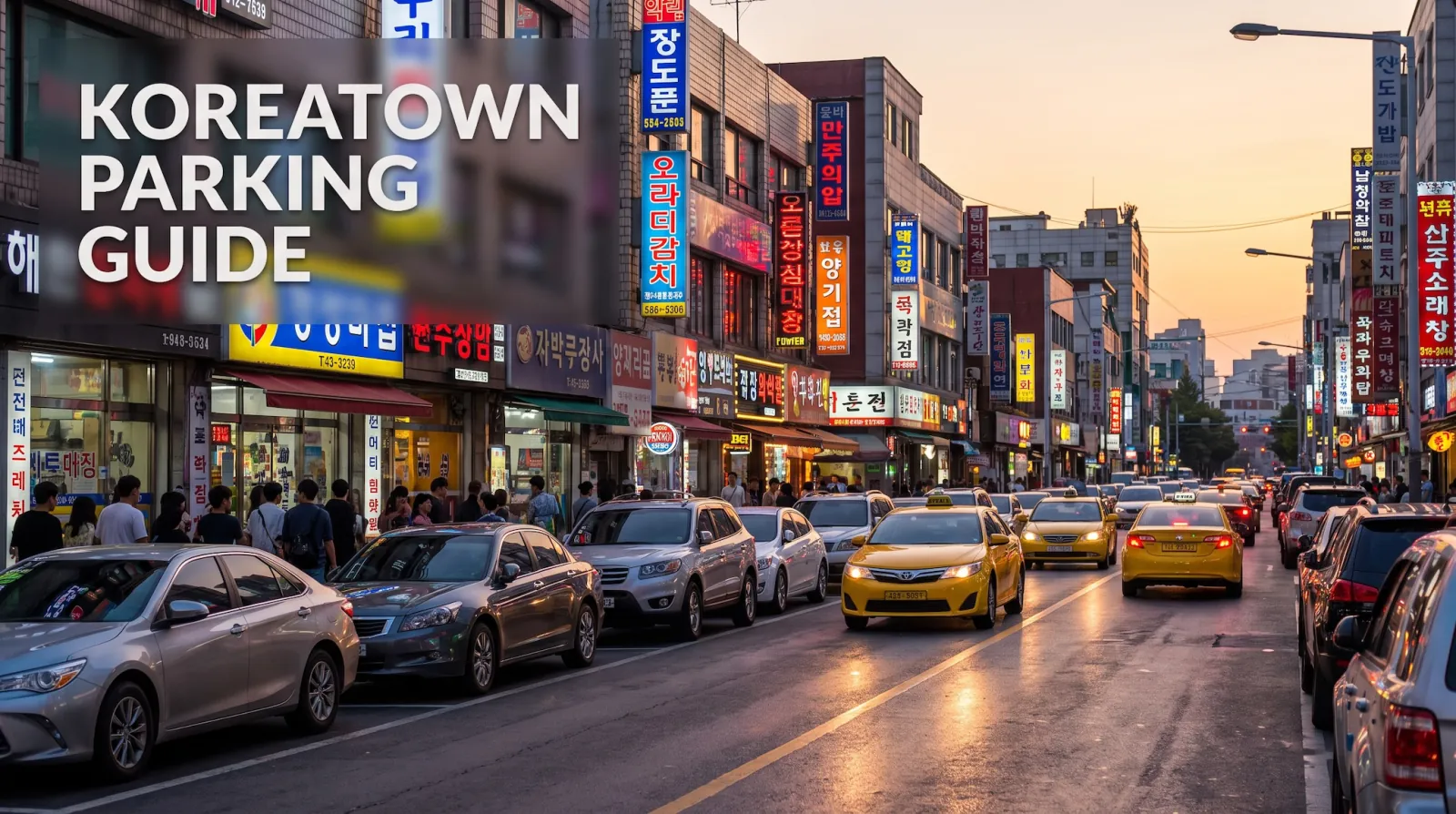
Koreatown is one of the most densely populated neighborhoods in the United States, and its parking reflects that. Apartment buildings without enough garage spaces, 24-hour restaurants and bars, and blocks packed bumper to bumper mean the competition for legal curb space is relentless — and the tickets pile up fast. Here's how to survive parking in K-Town.
Why Koreatown parking is so brutal
- Extreme density. More residents than curb space, full stop. Many apartment buildings predate parking requirements, so tenants rely on the street.
- Round-the-clock demand. K-Town doesn't sleep. Restaurants, karaoke, and bars keep blocks full late into the night, so there's rarely an "off" time to grab a spot.
- Permit districts and meters. Large stretches are inside preferential parking zones or metered, and enforcement is constant.
- Weekly street sweeping. Every block has its posted window, and with cars parked this tightly, a single sweep day clears an entire side of the street — and tickets anyone who forgot.
Street sweeping is the #1 ticket
In a neighborhood this packed, street sweeping generates an enormous share of citations. The rules are the same as the rest of LA, but the stakes feel higher because legal spots are so scarce:
- The city posts a weekly "No Parking" window per block, usually one to two hours in the morning.
- The two sides of a street often sweep on different days — a constant trap.
- A citation is about $73, and on tow-enforced blocks, blocking the sweeper can mean a tow that runs $450–$600 or more with 2026 impound rates.
Because K-Town legal spots are so hard to find, moving your car on sweep day often means circling for 20 minutes to re-park — which is exactly why so many residents just eat the ticket. It doesn't have to be that way.
Permits and meters
- Preferential parking zones cover much of residential K-Town. Without a district permit, you face time limits during posted hours; residents can apply for a permit that exempts them (but not from sweeping).
- Metered corridors along the major boulevards are enforced into the evening. Feed the meter and watch the time limit.
- Overnight is when demand peaks, so if you find a legal, unrestricted spot at night, check every sign before you leave it — a block that's fine at midnight can be a sweep zone at 8 AM.
The apartment-parking reality
The root of K-Town's parking problem is housing stock. Many of the neighborhood's apartment buildings were built before off-street parking requirements, or have far fewer garage spaces than units. That leaves a large share of residents competing for the same scarce curb space every single night — and it's why a legal, unrestricted overnight spot in Koreatown feels like winning a small lottery. Once you've got one, the last thing you want is to give it up on sweep morning and spend twenty minutes circling to find another.
The major corridors
The big boulevards each behave a little differently:
- Wilshire is metered and busy, with rush-hour restrictions on stretches — read the signs before parking during commute hours.
- Western, Vermont, and Normandie mix metered commercial frontage with dense residential side streets that are often permitted.
- Olympic and 8th run through some of the most parking-starved blocks in the neighborhood, where sweeping clears entire sides of the street at once.
Wherever you are, the side streets off these corridors are where permit zones and sweeping bite hardest.
The hidden cost: circling
In most neighborhoods, moving your car on sweep day is a minor annoyance. In Koreatown, it's a genuine time sink. Because legal spots are so scarce, re-parking often means driving several blocks, circling, and walking back — then repeating the whole thing when the sweep window ends and you want your spot back. Many residents do the math and decide the $73 ticket is less painful than losing their spot and burning half an hour twice. That's a rational choice given the constraints — but it means a lot of K-Town residents are effectively paying a monthly street-sweeping tax.
The Koreatown parking checklist
- Read the full sign stack — K-Town poles often carry permit, meter, and sweeping rules together.
- Confirm you're not in a permit-only window without a permit.
- Check street sweeping for your exact side of the street.
- Watch for temporary "No Parking" signs from construction, which is constant here.
- Photograph the signs by your car.
What it costs when you get it wrong
- Street sweeping and time-limit tickets: around $63–$73
- Permit violations: about $68
- A tow: $450–$600 or more
For a K-Town resident with a weekly sweep day and no garage, that easily adds up to $600–$900 a year — sometimes more.
The hands-off option for Koreatown residents
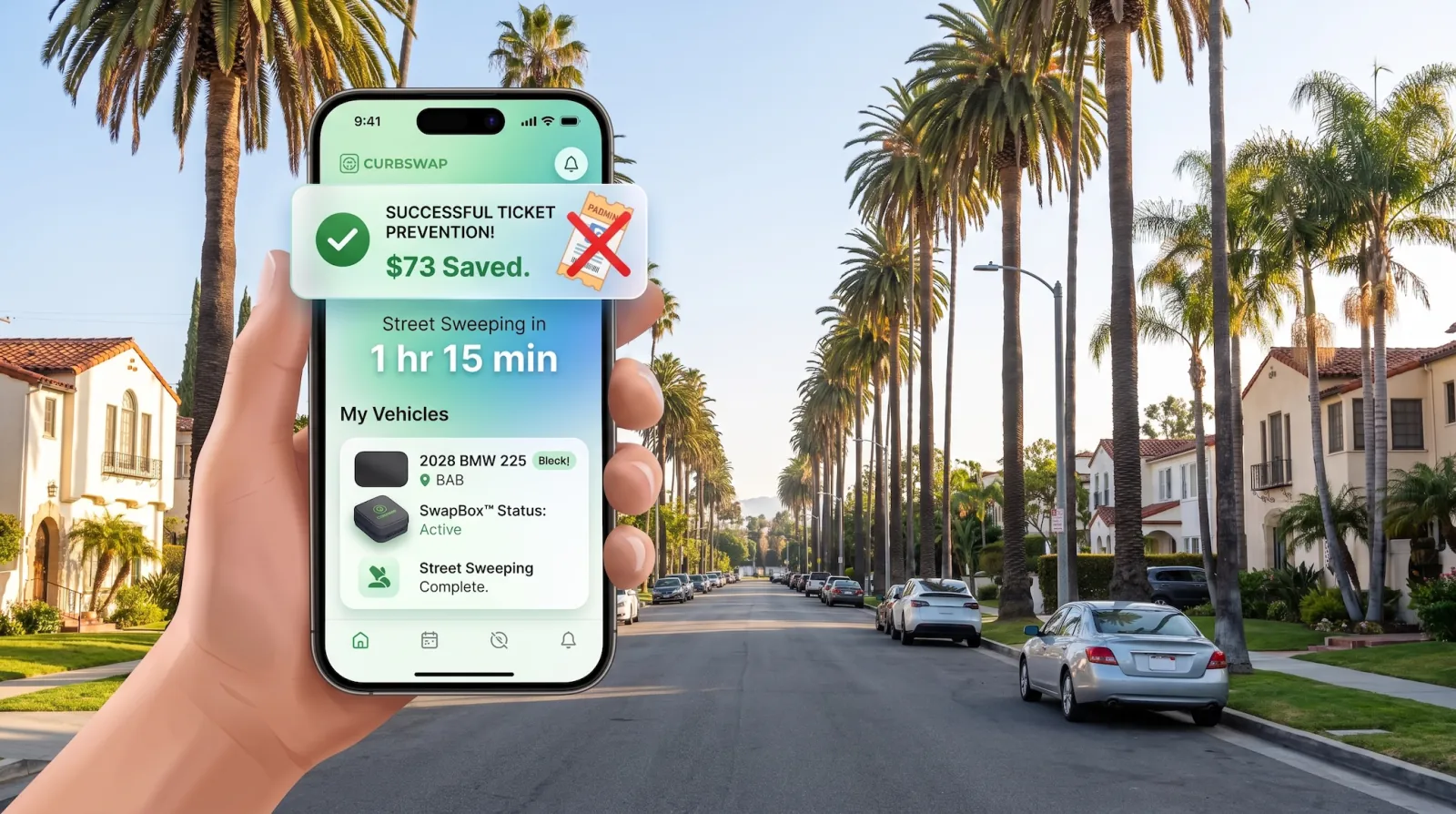
Koreatown is exactly the kind of neighborhood Curbswap was built for: dense, permit-heavy, and swept every week, where re-parking on sweep day means losing your spot and circling for another. A vetted Curbswap driver relocates your car to a legal spot before the window begins and sends you photo and GPS proof — no alarm, no circling, no ticket. Because K-Town is one of LA's hardest parking markets, it's also one of the first areas we're opening.
An overnight-parking strategy
If you park on the street in K-Town every night, a little routine goes a long way:
- Grab a legal spot as early as you reasonably can. Demand only climbs through the evening, so the 7 PM version of your block is very different from the 10 PM version.
- Memorize your sweep days — both sides. Write them down, set two phone alarms, and know a fallback block that sweeps on a different day so you're not scrambling.
- Check for temporary signs before you settle in for the night. Construction is constant in K-Town, and a block that's fine at midnight can be posted no-parking by morning.
- Don't push a permit time limit "just this once." Enforcement here is steady, and the odds are not in your favor.
What it really costs over a year
Put numbers on it. A resident who misses one sweep window a month is looking at roughly $876 a year in street-sweeping tickets alone — and that's before a single tow, before any permit or meter slip-ups, and before the hours lost circling for a replacement spot. Add one tow at $450–$600 and you're comfortably over a thousand dollars for the year. Framed that way, the "just eat the ticket" strategy that feels rational in the moment is quietly one of the most expensive habits in the neighborhood.