
If you've ever parked on a residential LA street and found a two-hour limit that seems to apply to everyone except the cars with a little sticker, you've run into a preferential parking district. Residential permits are one of the most misunderstood parts of parking in Los Angeles — what they do, what they don't do, and who needs one. Here's a plain-language explainer.
What is a preferential parking district?
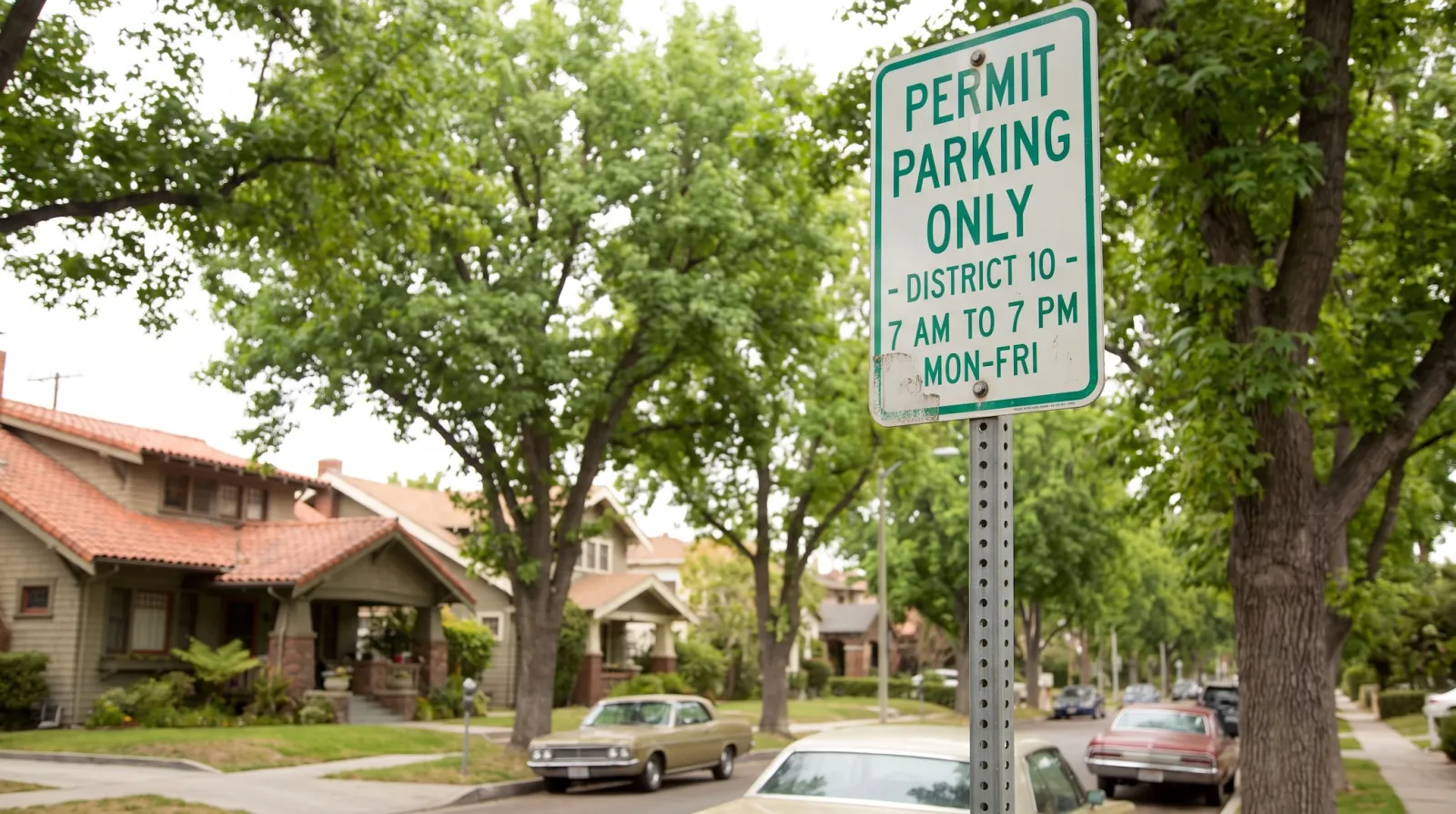
A preferential parking district (sometimes called a permit district) is a residential area where the city limits parking for vehicles without a district permit. The goal is to protect residents' access to curb space from commuters, event crowds, and spillover from nearby commercial areas.
On these blocks you'll see signs like "2 Hour Parking 8 AM–6 PM — Except by Permit." That means a non-permit vehicle can park for up to two hours during those hours; a vehicle with a valid district permit is exempt from the time limit.
What a residential permit does
A residential permit exempts your vehicle from the time limits and permit-only restrictions on the blocks within your district. In practical terms, it lets you park on your own residential streets for as long as you like during posted permit hours, without getting a time-limit ticket.
There are usually a few permit types:
- Annual resident permits for vehicles registered to an address inside the district.
- Visitor permits — a limited number of passes or hangtags so guests can park without a time-limit ticket.
- Short-term or daily permits in some districts for temporary needs.
What a permit does NOT cover
This is where people get tripped up. A residential permit does not exempt you from:
- Street sweeping. This is the big one. A permit has nothing to do with sweeping — if you're parked during your block's posted "No Parking / Street Sweeping" window, you get a ~$73 ticket regardless of your permit.
- Red zones, no-stopping zones, and hydrants. Safety restrictions always apply.
- Rush-hour tow-away zones on major corridors.
- Temporary "No Parking" signs for film shoots, construction, or events.
- Metered parking in commercial areas.
In other words, a permit solves one specific problem — time-limit enforcement on your residential blocks — and nothing else. Plenty of permit-holders still collect street-sweeping tickets every month.
How to get a residential permit
The process is run by LADOT, and the general path looks like this:
- Confirm your block is in a district. Not every residential street has preferential parking; check whether your address falls inside an established district.
- Prove residency and vehicle registration. You'll typically need to show that you live at the address and that the vehicle is registered there (or provide accepted documentation if it isn't).
- Apply and pay the permit fee. Annual resident permits and visitor permits carry modest fees set by the city.
- Display it correctly. Follow the district's rules for stickers or hangtags so enforcement can see it.
Because the specifics — eligibility, fees, visitor-permit limits — vary by district and change over time, confirm the current requirements with LADOT before you apply.
Visitor permits: the part people forget
Most districts issue a limited number of visitor permits — hangtags or scratch-off passes that let your guests park without a time-limit ticket. If you host friends and family, or you have a caregiver, house cleaner, or contractor who parks for more than the posted time limit, visitor permits are the difference between a welcome and a windshield ticket. They're usually capped per household and per year, so treat them as a limited resource: use them for the visits that would otherwise overrun the time limit, and know how to request more if your district allows it.
Common permit mistakes
A few traps catch even long-time permit-holders:
- Assuming the permit covers sweeping. It doesn't. This is the single most common — and most expensive — misunderstanding.
- Letting the permit lapse. Annual permits expire; an expired sticker is treated like no permit at all.
- Displaying it wrong. If enforcement can't see a valid, current permit, you can be cited even if you have one. Follow your district's display rules exactly.
- Parking on a different district's blocks. Your permit is tied to your district. Park in a neighboring permit district and the time limit applies to you like anyone else.
- Registration mismatch. Permits are generally tied to a vehicle registered at the address; keep your registration current and matching.
Contesting a permit-zone ticket
If you're ticketed in your own district while displaying a valid permit — or if the signage was missing, faded, or contradictory — you can contest the citation through the city's review process. Photos of your displayed permit and the posted signs are your best evidence. As with any parking citation, a meaningful share are dismissed on review when the driver has a legitimate case and the documentation to back it up.
Do you actually need one?
If you park on the street in a permit district and you're getting time-limit tickets, yes — a permit removes that entire category of risk. If you have reliable off-street parking, or your block isn't in a district, you may not need one.
But remember the ceiling on what a permit buys you: it does nothing for street sweeping, which is the single most common ticket in Los Angeles. A permit-holder who forgets sweep day is just as exposed as anyone else.
The piece a permit can't solve
A residential permit fixes the time-limit problem. It can't move your car off the curb on sweep morning. That's the recurring, predictable ticket that a permit leaves wide open — and it's exactly what Curbswap handles. A vetted driver relocates your car to a legal spot before the sweeping window begins and sends photo and GPS proof, so a permit plus Curbswap covers the two biggest residential parking risks at once. Curbswap is launching across LA neighborhood by neighborhood.