Does a Disabled Placard Get You Out of a Street Sweeping Ticket in LA?
ExplainerOctober 27, 20264 min readBy Curbswap Team
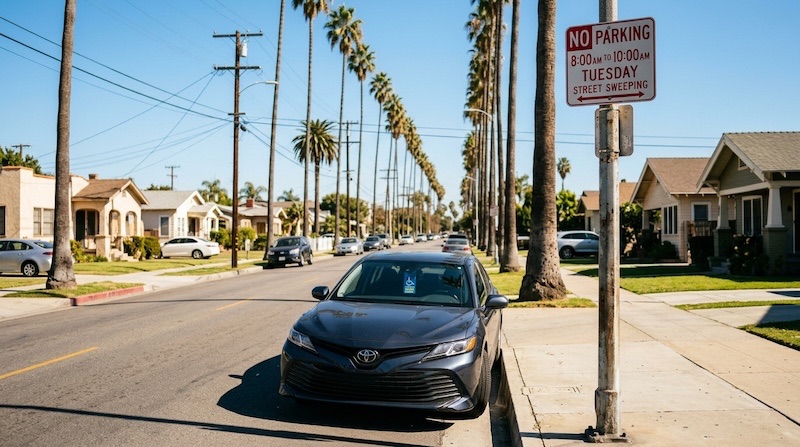
No. A disabled placard or plate does not get you out of a street-sweeping ticket in Los Angeles. It buys you real privileges elsewhere — free metered parking, no time limit in a restricted zone — but a posted "No Parking, Street Sweeping" sign isn't one of them.
What the law actually says
California Vehicle Code Section 22511.5 is generous by design. A disabled person or disabled veteran displaying a valid placard or special plate can park unlimited periods in any zone restricted as to the length of time parking is permitted, and can park at a meter without paying it. That's the placard doing real work: a two-hour zone becomes unlimited, a meter becomes free.
The same section also carves out the exception that matters here — the privilege "does not apply to a zone for which state law or ordinance absolutely prohibits stopping, parking, or standing of all vehicles." A street-sweeping sign isn't a time limit you're allowed to ignore. During its posted window, it's a flat "no parking, period," for every car on the block, placard or not. That's an absolute prohibition, not a time restriction, and the statute draws the line exactly there.
Why this trips people up
The confusion is understandable. Almost everywhere else in the city, a placard means "the normal rule doesn't apply to me." A two-hour zone, a green curb, a meter — placard holders get used to being the exception. Street sweeping is the one common LA restriction where that habit fails, because it isn't rationing time, it's clearing the whole block for a truck on a schedule.
LADOT's street-sweeping program is blunt about enforcement: vehicles will be cited if they're parked in a posted zone when cleaning is scheduled. The posted signage doesn't carve out an exception for disabled placards, and neither does the citywide enforcement policy.
What a placard still covers in LA
To be clear about what you keep, because it's a genuinely strong set of privileges:
Metered parking. Park free, with no time limit, at any meter in the city.
Time-limited zones. A 2-hour zone or a green curb time limit doesn't apply to you — you can stay as long as you need.
Preferential parking permit districts. You don't need the resident permit other cars on that block are required to display.
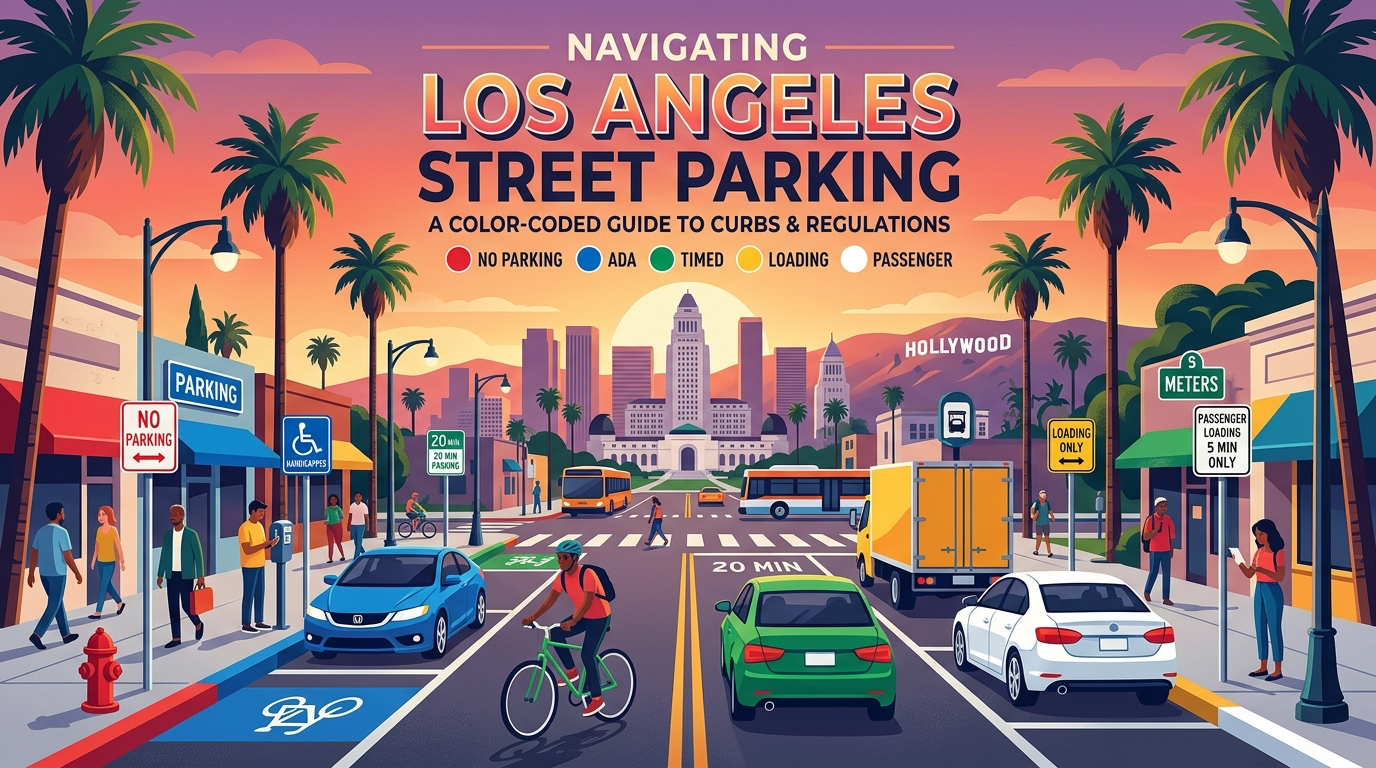
None of that reaches street sweeping, and none of it reaches a red curb or another zone where parking is flatly banned. A blue curb is a separate rule — a specific space reserved for placard holders, created locally under the city's own disabled-parking-zone ordinance — and if that block also has a posted sweeping day, the blue curb gets swept too, on schedule, same as everything else.
What it costs if you get it wrong
A street-sweeping citation in LA runs $73, the same fine anyone else pays — there's no reduced or waived rate for placard holders. On a tow-enforced block, the car gets towed instead of ticketed, and impound costs stack fast: roughly $450–$600 once the tow fee, daily storage, and release fee are added up. The placard doesn't change either number.
How to actually protect yourself
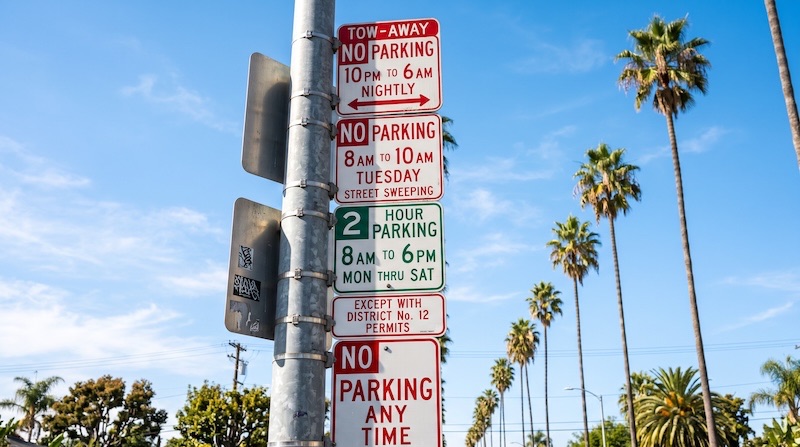
Read the sign at your specific spot, not just the curb color. A plain, uncolored curb can still carry its own posted street-sweeping day and time that has nothing to do with any placard rule or curb color.
Don't stretch "unlimited time" to mean "any restriction." Unlimited applies specifically to time-limit zones. Sweeping is a scheduled ban, not a limit you can outlast.
Check the two layers separately. A block can be a completely legal, unmetered, unrestricted spot for most of the week and an absolute no-parking zone for two hours of it, every single week, on the same schedule.
If your car sits for days at a time, the sweeping window is the one that eventually catches everyone, placard or not. It's worth knowing the exact day and time for wherever you regularly park, not just the general rules that usually work in your favor.
The bottom line
A disabled placard is one of the strongest parking exemptions in California law — free meters, no time limits, no permit required almost anywhere else. That strength is exactly why it's easy to over-trust: it covers so much of ordinary parking that people assume it covers all of it. Street sweeping is the deliberate exception, written into the same statute that grants the privilege, and Los Angeles enforces it exactly as written — every car moves, or every car left behind gets cited.
That's true with or without a placard, and it's the same recurring problem Curbswap exists to remove: a vetted driver relocates the car to a legal spot before the posted window opens, with photo and GPS proof, so there's nothing to track and nothing to get wrong. Curbswap is rolling out across Los Angeles neighborhood by neighborhood.
disabled parking placardstreet sweeping ticketparking rules los angelesADA parking california
Never get a parking ticket again.
Curbswap moves your car before street sweeping hits — hands-off, with photo + GPS proof. The app is live: check your street’s rules for free.