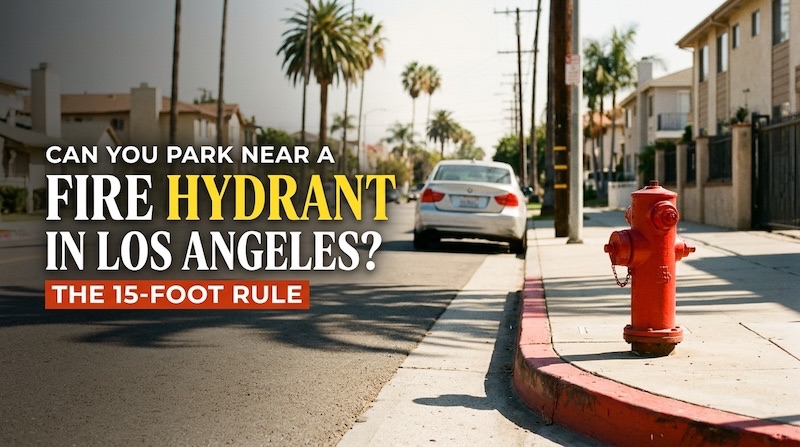
No. In Los Angeles — and everywhere else in California — you can't park within 15 feet of a fire hydrant, measured on both sides of it. That's not a city ordinance you can talk yourself out of because the curb isn't painted. It's state law, and the paint has nothing to do with it.
Where the rule actually comes from
The 15-foot distance comes from California Vehicle Code Section 22514. It bars parking within 15 feet of a fire hydrant, full stop — no mention of curb color, no carve-out for a quick errand. LADOT enforces it in Los Angeles the same way it enforces every other posted or coded parking restriction, as one of the standard prohibited-parking situations listed on LADOT's own site.
Most people assume the rule only kicks in when the curb is painted red. It doesn't. Red paint is how a city chooses to mark a no-parking zone in advance, as a courtesy. The hydrant itself is the actual trigger, painted curb or plain gray concrete.
The curb not being red doesn't help you
This is the part that actually costs people money. Driving around Los Angeles, you'll see plenty of fire hydrants with no red curb at all — just a hydrant sitting on an ordinary stretch of sidewalk. Nothing about the pavement signals a restriction. The instinct is reasonable: no paint, no rule. It's also wrong. The law measures from the hydrant, not from any paint job, so an unmarked hydrant carries exactly the same 15-foot zone as one with a bright red curb underneath it.
If you're deciding whether a spot is legal, look at the hydrant, not the ground around it.
How far is 15 feet, really
Fifteen feet is roughly one sedan length. Since the rule applies in both directions, you're really looking at a clear zone of about 30 feet total, centered on the hydrant — call it two car lengths, one in front and one behind. If your bumper would land anywhere inside that stretch on either side, it's not a legal spot, even if there's technically room to fit the car.
A rough way to eyeball it without a tape measure: five normal adult strides covers close to 15 feet. Pace it off from the hydrant before you commit to the spot.
The one real exception
The statute allows a vehicle to stop near a hydrant only if it's attended by a licensed driver capable of moving it immediately — someone behind the wheel, not someone who ducked inside a store. The moment you step away and the car is unattended, the exception is gone and the violation starts. It also doesn't apply if a fire crew or utility crew is actively using the hydrant; that clearance exists so hoses can be connected and equipment can be positioned without a parked car in the way, which is the actual safety reason behind the rule.
What it costs
LA's fine schedule varies by violation type and the city periodically revises amounts, so the exact dollar figure on a fire-hydrant citation isn't something we can state precisely without seeing the current posted schedule for that specific code. What we can say from our own breakdown of LA parking fines is that restrictions in the same no-stopping family as hydrant zones — red curbs and clearway violations — tend to run on the higher end of LA's fine range, around $93 and up, not the lower $58–$73 band that covers things like an expired meter or a time-limit overstay. If your car gets towed instead of just ticketed, that adds tow and storage fees on top, commonly pushing the total past $400.
The habit that actually avoids this
There's no app or sign that reliably flags every hydrant for you — the fix is just checking before you park, the same way you'd check for a red curb, a driveway, or a crosswalk. If a hydrant is anywhere near the spot, assume the 15 feet applies whether or not the pavement is painted, and move on to the next space.
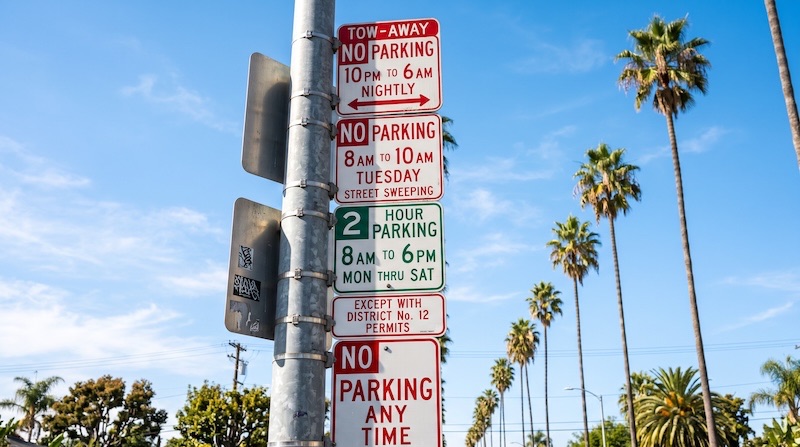
This is one small piece of a much bigger pattern in LA: the rules that actually get you ticketed are rarely the ones with the most paint on the curb. Street sweeping is the biggest example — a completely unpainted, unremarkable block of curb that still carries a posted sweeping day and time, and accounts for more tickets than almost anything else in the city. Curbswap exists for that specific, recurring problem: a vetted driver relocates your car to a legal spot before the sweeping window hits, documented with photos and GPS, so you're not out there eyeballing curbs and hydrants on a deadline. Curbswap is rolling out across Los Angeles neighborhood by neighborhood.
Never get a parking ticket again.
Curbswap moves your car before street sweeping hits — hands-off, with photo + GPS proof. The app is live: check your street’s rules for free.